

The consequences of new electricity consumers can only be meaningfully assessed with the marginal flow approach. This is precisely why there are often strong defensive reactions, such as „I think the marginal power argument is idiotic“. There is a need for clarification.
E-car fans do not deny that part of the electricity is generated by fossil fuels. But they believe that the charging current will become more and more environmentally friendly over time and that they are already driving emission-free under certain circumstances.
A widely held belief is that the higher the green power quota of the average electricity, the less emissions electric cars produce. At first glance, this seems quite plausible.
To understand the actual relevance of the composition of the electricity from your own socket, let’s start with the special case of partial self-supply with green electricity. Let us assume that an electric car owner obtains the charging current from his own PV system:
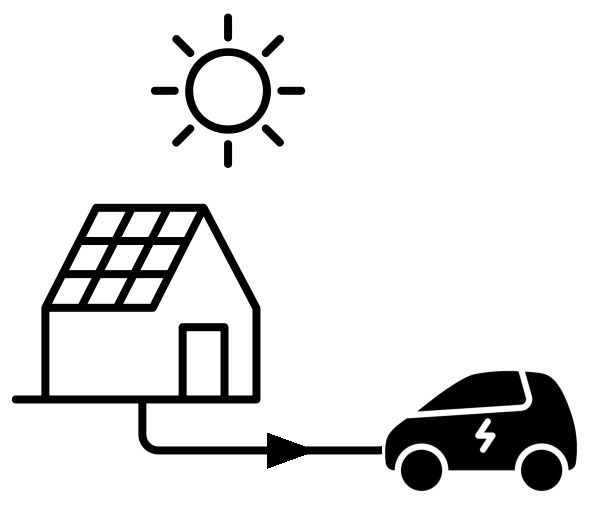
Does this car run on green electricity?
„Sure, with solar power, what else?“ is a common answer.
But if you take a second look, doubts arise.
The illustration only shows the state of battery charging. However, the PV system had already generated electricity beforehand and used it to supply other consumers – in this case, the home’s electrical system. As soon as this electricity is needed for the electric car, it is no longer available for previous consumers. The charging current must now be replaced by other sources.
This is the reason why almost all houses with PV systems are connected to the electricity grid:
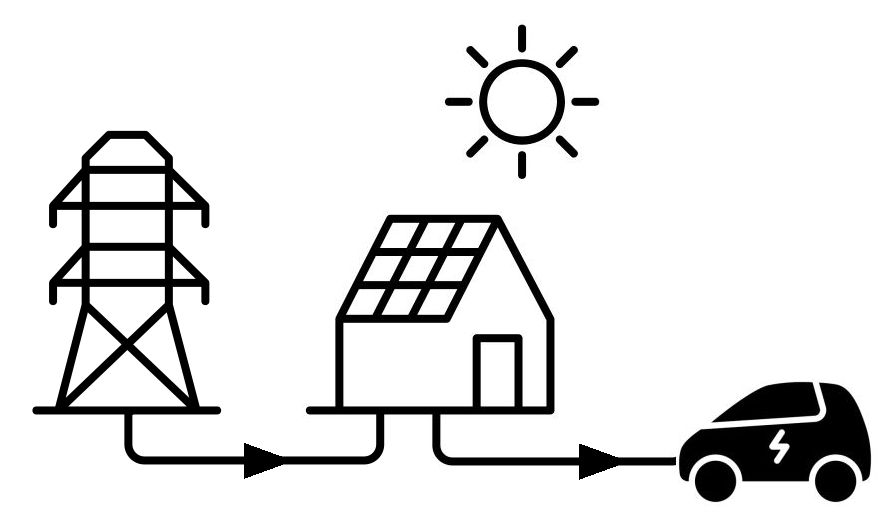
The question of whether this e-car is emission-free now appears in a different light: Obviously, it does not matter where the charging current of this car comes from. Instead, it needs to be clarified which power plants generate the additional current that is now needed so that the lights don’t go out in the house. In the best case, these are wind or solar power plants. But what if coal-fired power plants generate the additional electricity?
Conclusion 1: E-cars can cause very high CO2 emissions even if they are charged with solar power.
This conclusion also applies in the case that the solar power was not consumed by the owner before the charging process began, but was fed into the grid:

As soon as the e-car is connected and the charging process begins, the feed-in to the grid ends. The electricity requested by the e-car must be replaced by other power plants.
(If the e-car owner does not have his own PV system on the roof, his car’s battery will of course always request additional power from the grid).
Conclusion 2: Where the electricity for a particular charging process comes from has no influence whatsoever on greenhouse gas emissions. The additional emissions depend entirely on which power plants generate additional current.
But why additional power – why can’t the emissions simply be determined with the average power?
The reason is that in the case of load fluctuations, definitely not all power plants are regulated up or down equally: Only adjustable power plants adjust their output. And unfortunately, almost only thermal power plants that burn coal, natural gas or oil are regulated:
- Nuclear power plants are technically adjustable, but have such low running costs that they almost always operate at full load.
- There is a feed-in priority for electricity from wind and solar power plants. This capacity is almost always fully fed into the grid and can therefore not be increased if required (capping only occur in the event of local grid bottlenecks and, according to the German Federal Network Agency, affect less than
3 % of the annual production from renewable energy current).
The distinction between regulable and non-regulable power plants applies both to short-term fluctuations in demand every minute and to predictable and plannable shifts.
Conclusion 3: If only a part of the power plants contributes to the production of the additional power, then of course only this part may be used to determine the emissions of additional electricity consumers such as e-cars.
The emissions of the individual charging process
Is it even possible to determine the exact emissions of a particular charging process of an e-car?
This task is challenging because charging batteries often takes several hours. Therefore, the additional current may be generated by different power plants at the beginning than towards the end. This makes it necessary to analyse the power generation to the minute. Because electric current takes the path of least resistance and prefers short distances, it can also be assumed that the additional current comes primarily from fossil power plants from the surrounding region (up to approx. 200 km). Which power plants supply which share at which time can only be determined with great effort.
For climate balances, however, this is not necessary at all…
The emissions from electromobility as a whole
For carbon footprints, it is not the emissions of the individual vehicle that are relevant, but those of electromobility as a whole.
Carbon footprints are intended to inform politicians about the impact on greenhouse gas emissions of introducing new electricity-consuming products. The aim is to create a scientific basis for legal regulations to promote certain forms of electricity generation or use. Because these always affect entire countries or even continents, the entirety of all vehicles is considered in the case of e-cars. The greenhouse gas emissions of electromobility are the sum of all emissions that result from the fact that there are e-cars at all – or would be avoided if there were no e-cars. Serious CO2 balances of e-cars as an alternative to cars with internal combustion engines must therefore compare two system states:
1. The entire power grid with additional production of charging power for electric cars.
2. The same power grid without the charging current additional load.
It is therefore sufficient to observe how the power grid reacts to major fluctuations in demand.
Empirical evidence impressively confirms that load fluctuations are almost only compensated by fossil power plants. The Covid19 crisis year 2020, when electricity demand fell due to the lockdowns, was reported by the think tank AGORA:
„Coal-fired power generation in particular reached a new low since holistic records began in 1990 … The drop in demand affected fossil-fuel generation almost exclusively, as they are behind renewables in the merit order – the deployment order of power plants when selling electricity on the exchange – and are thus the first to reduce their generation.“
The International Energy Agency confirmed this observation for almost the entire world.
Electricity that has to be produced additionally due to increasing demand (or not due to decreasing demand) is called marginal electricity. Only this is relevant for the carbon footprint of additional or omitted consumers. However, the electricity grid naturally does not „know“ for what reasons the demand for electrical energy fluctuates. Therefore, there is no plausible reason to assume that it would react differently to changes in the demand for charging current.
It is thus proven that the additional electricity demand of electromobility predominantly increases fossil electricity production. The high coal content of the marginal electricity has a fatal effect on the e-car, as shown in a graph from the EU from 2019 (published until spring 2022; the lowest bar shows the high emissions of e-cars when electricity generation is powered by coal):

Conclusion 4: If the emissions of electromobility are correctly determined with the marginal current, e-cars by no means have lower emissions than vehicles with combustion engines
But electricity generation from renewable sources is being expanded specifically for BEVs, isn’t it?
Solar panels and wind turbines are electricity generators, e-cars are electricity consumers.
Solar panels and wind turbines increase the green electricity quota, e-cars decrease it.
This is always the case, without exception. The reasons why solar panels and wind turbines were erected are irrelevant for this.
Moreover, this assertion can easily be refuted with a counter-question. Suppose e-cars were to be banned: Why should that be a reason to slow down the defossilisation of the energy supply? The demand for green power will increase rapidly due to the many electrification projects and the rising need for hydrogen. Thus the assumption that without e-cars less green electricity would be produced is not plausible.
About the benefits of flexible charging
Some e-car drivers try to reduce charging current emissions by shifting charging to phases with „plenty of wind and solar power in the grid“. Does that really make sense?
This question actually answers itself now. Because „a lot of wind and solar power in the grid“ always refers to the composition of the average electricity. However, as shown above, this is not the point.
If the charging process is started, even with a high green power quota, only the output of the fossil power plants is increased in the grid. Solar and wind turbines are already running at full capacity.
The composition of average and marginal electricity is, on the one hand, highly variable and, on the other hand, independent of each other: depending on the availability of the power plants and current prices, it is possible that in phases with a high green electricity quota of average electricity, the additional electricity nevertheless contains a lot of coal-fired electricity. Conversely, it may well be that when the green electricity quota of the average electricity is low, additionally required marginal electricity is predominantly produced by gas-fired power plants and is therefore relatively clean.
Conclusion 5: Waiting for phases with „clean“ average current to charge the battery is a ritual act with no effect on emissions
E-car fans like to claim that it would make more sense to use electricity given away abroad as charging power.
When there is a lot of wind and sun, it is already the case today that more green electricity is generated in one country than can be consumed in that country at that time.
Due to the feed-in priority, this surplus must be exported, which can even lead to negative prices. Could this electricity be used more sensibly as charging electricity for e-cars?
No, that is not the case.
The low or sometimes even negative export prices are a purely economic problem and are due to the dysfunctional design of the European electricity market. In fact, this electricity is also used abroad to force fossil electricity out of the grid. If it is not exported to charge e-cars, fossil-fuel power plants abroad continue to run at a correspondingly higher output. In terms of climate protection, however, it is irrelevant whether greenhouse gas emissions are reduced in Germany or in other European countries.
Conclusion 6: Using electricity that is „given away“ to other European countries as charging power in the domestic market does not improve the climate footprint of the electric car.
(The first three graphics are from flaticon.com/free-icons).
 Über Sinn und Unsinn rollfähiger Akkupacks