Not only the German Greens, SPD, IG Metall and the EU Commission, but also the Democrats in California are dreaming of putting an end to the combustion engine by 2035.
They have set out how they intend to achieve this in a paper entitled „2022 State Strategy for the State Implementation Plan“: „Advanced Clean Cars 2 is a significant effort critical to meeting air quality standards that is still being developed to cut emissions from new combustion vehicles while taking all new vehicle sales to 100 percent zero-emission no later than 2035.“
The term „zero-emission“ refers to electric cars.
Although the European Commission has taken a few years, it seems to have come to a ground-breaking realisation: it has understood that electric cars are not zero-emission vehicles if part of their electricity comes from fossil fuel power plants.
This also applies to California. In 2022, almost half of the electricity was supplied by natural gas power plants. However, this has not yet been able to slow down the drive of the California Air Resources Board (CARB). Its proposals for air pollution control are unwaveringly based on the Final Statement of Reasons for Rulemaking von 1996. It claims, among other things, that “even at the high end of the range of estimates, the emissions associated with power plants are ten times lower than the tailpipe emissions from the lowest emitting vehicle required by ARB in the future under any existing regulation.”
If this is true, there can be no doubt that car transport must be electrified as quickly as possible. But is it really true?
CARB uses the GREET life cycle model from the Office of Energy Efficiency & Renewable Energy, among others, to assess the various types of drive. The American management consultancy Stillwater Associates took a closer look at the data and came to some astonishing conclusions:
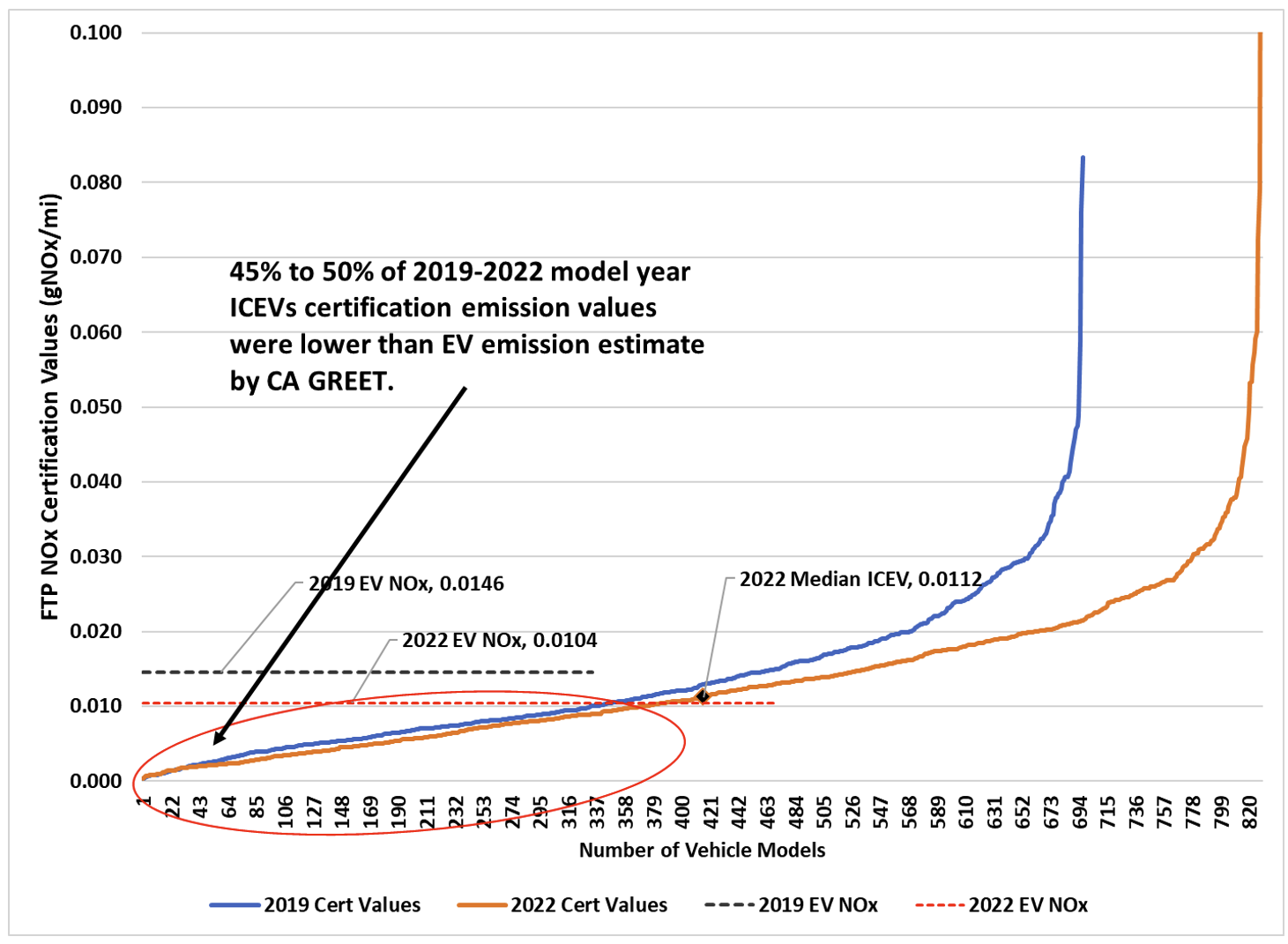
1. The exhaust gases of almost every second ICEV*1 model that was available as a new vehicle between 2019 and 2022 contain less nitrogen oxide than is emitted by power plants to generate charging current
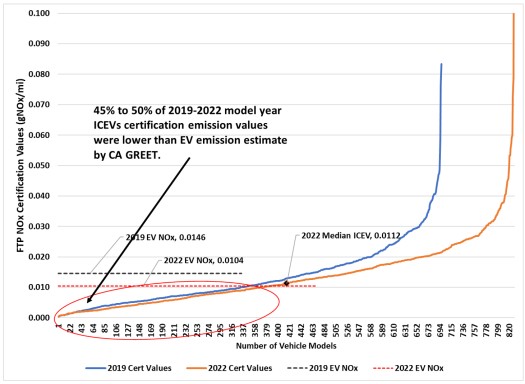
Graphic created by Stillwater Associates (for higher resolution click here)
Data sources: Annual Certification Data for Vehicles, Engines, and Equipment | US EPA and Ca GREET EV Results
The ICEV models are listed on the x-axis in order of their nitrogen oxide emissions. The median is shown in the curve with the ICEV emissions in 2022 (i.e. there are just as many ICEV models with higher emissions as with lower emissions). The broken horizontal lines mark the nitrogen oxide emissions of the charging current for electric cars in 2019 and 2022.
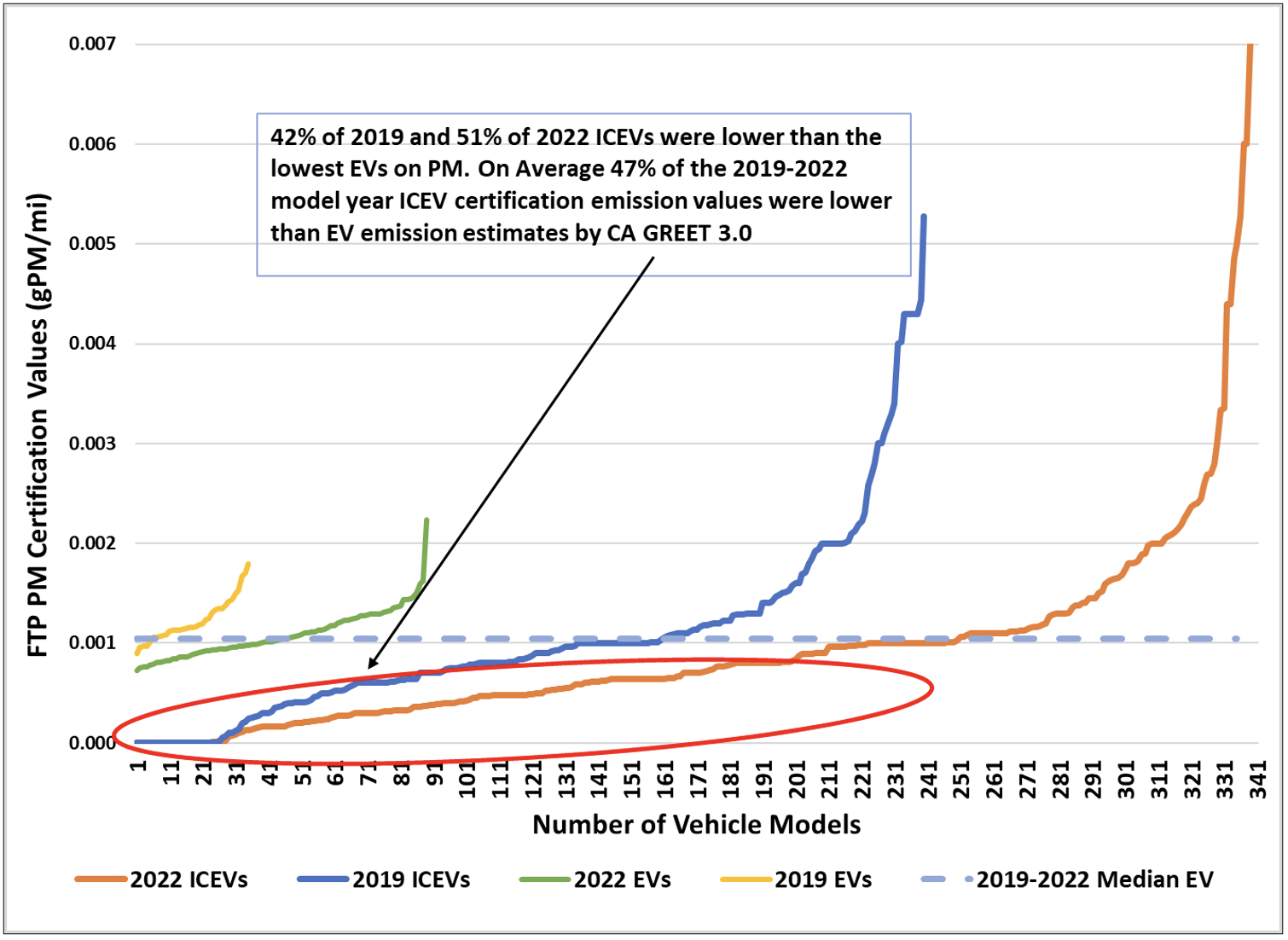
2. Almost every second model with an internal combustion engine also emitted less particulate matter during this period than electricity generation for electric cars
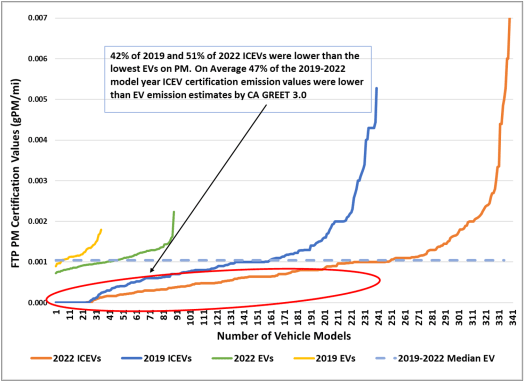
Graphic created by Stillwater Associates (for higher resolution click here)
Data sources: Annual Certification Data for Vehicles, Engines, and Equipment | US EPA and Ca GREET EV Results
The cleaner ICEVs are predominantly smaller and cheaper. In addition, more than ten times as many ICEVs were sold as BEV*2. As a result, according to Stillwater Associates, significantly more low-emission ICEVs than BEVs hit the roads between 2019 and 2022.
Conclusion:
Many cars with internal combustion engines have lower nitrogen oxide and particulate matter emissions than are produced by the charging current for electric cars, and are sold in greater numbers than these. They therefore make a greater contribution to air pollution control. The CARB’s recommendation to electrify car traffic as quickly as possible ignores the progress made in exhaust gas purification and delays the improvement in air quality.
Do electric cars at least have lower CO2 emissions?
The vast majority of life cycle assessment studies on electric vehicles confirm this. However, a closer look often reveals a fundamental systematic error. Many authors calculate the emissions of the charging current using average electricity emissions. This approach implicitly assumes that greenhouse gas emissions from electricity generation are load-independent. This is clearly wrong, as load fluctuations are primarily balanced out by controllable (mostly fossil-fuelled) power plants.
CARB has done an impeccably solid job in this respect from the outset and has always applied the marginal approach. Quote: „ARB staff worked with the California Energy Commission staff to evaluate power plant emissions associated with EVs. The analysis was done using the Electricity Financial model to predict the marginal power usage of EVs in 2010.“
The same applies to the GREET model on which the two diagrams are based.
What does this mean for greenhouse gas emissions from electric cars in the USA?
Let’s take a look at the results of a study from 2023 (also based on the marginal approach). The findings are quite clear: „We find that currently there is no evidence to support the idea that BEVs lead to a uniform reduction in vehicle emission rates in comparison to HEVs and in many scenarios have higher GHG emissions.“
If policymakers really want to improve air quality and reduce greenhouse gas emissions first and foremost, why don’t they choose the quickest and most cost-effective route?
The CARB data cannot be used to justify a ban on combustion engines.
P.S.
This article is based on a highly recommended article by Stillwater Associates employee Gary Yowell entitled „Do EVs reduce NOx or PM emissions more than combustion engine vehicles? The answer may surprise you.“
*1: ICEV = Internal Combustion Engine Vehicle
*2: BEV = Battery Electric Vehicle
Header graphic: https://www.pexels.com/de-de/foto/strasse-gebaude-mauer-wand-11615536/
 Über Sinn und Unsinn rollfähiger Akkupacks